


Built by Science. Proven in Performance.
InnovAAte’s research is led by world-renowned scientists:
Prof. Hugh Dunstan (D.Phil, Oxford): ResearchGate profile with links to publications
Prof. Tim Roberts (PhD, Flinders): ResearchGate profile with links to publications
Dr. Margaret Macdonald (D.Phil, Oxford): ResearchGate profile with links to publications
With over 270 peer-reviewed publications combined, our team has contributed decades of insight into amino acid metabolism, hydration science, and exercise biochemistry.
Every InnovAAte product is backed by this expertise—and developed to help people live, train, and recover better.
From Curiosity to Clinical Discovery.
At InnovAAte, every formula we create is built on decades of research into the role of amino acids in physical performance, stress, and recovery. We don’t guess. We test, model, and publish. Our products are developed by leading scientists who have spent their careers understanding the body’s biochemical needs—especially under physical strain.
It all started with a question:
What does your body really lose when you sweat?
The answer changed everything.
The research that formed the foundation of the HDAA concept
Three scholarly research articles specifically investigated amino acid losses through sweat to determine that six amino acids are lost in substantially greater quantities than the other amino acids in the body.
Quantifying Sweat-Facilitated Amino Acid Loss (SFLAA) and Catabolic Risk
This paper demonstrates that exercise-induced sweating causes substantial sweat-facilitated amino acid loss (SFLAA), which threatens plasma homeostasis and triggers skeletal muscle proteolysis. It maps sweat kinetics to show that initial amino acid leaching from skin surfaces diminishes after 35 minutes, giving way to true eccrine clearance.
Finally, utilizing principal component analysis, the study phenotypically stratifies athletes into Low, Intermediate, and High SFLAA clusters. This identifies high-excretors who lose up to 22.8 mmol/h of amino acids, establishing a clinical rationale for targeted free-form amino acid supplementation.

Modelling Amino Acid Turnover: What Happens When You Push Too Far
This paper establishes a predictive amino acid turnover paradigm that calculates net daily nitrogen balances across specific amino acids under distinct physiological states. By integrating real-world excretion rates, it demonstrates that routine exertion drives negative balances for histidine, serine, glycine, and ornithine, particularly scaling with higher body masses.
Crucially, it models localised metabolic bottlenecks—showing how fasted exercise forces skeletal muscle catabolism, while acute infectious challenges selectively drain tyrosine, threonine, and valine for IgG synthesis. This provides a strong clinical rationale for low-dose, targeted amino acid replenishment.
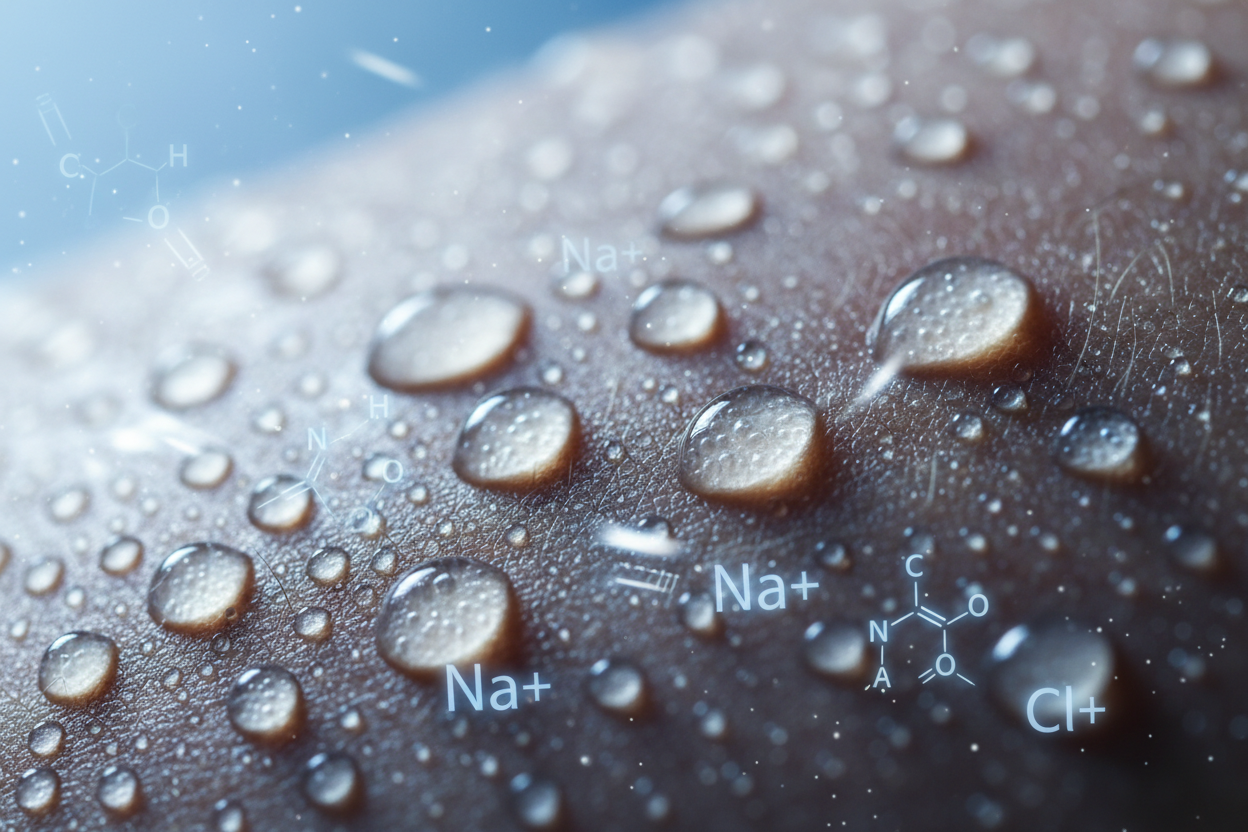
Ductal Resorption Mechanics: How Amino Acids and Potassium Govern Sodium Reclamation
This paper establishes that eccrine sweat is a physiologically "constructed fluid" where free amino acids and potassium actively drive the ductal resorption of sodium and chloride. By tracking sweat composition across prolonged exercise, it demonstrates a strong inverse relationship between certain amino acids and sodium and chloride.
- As cellular reservoirs of amino acids and potassium deplete over time, the duct's capacity to reclaim sodium and chloride declines, causing sweat concentrations of these key electrolytes to rise significantly.
- In other words, sodium and chloride are lost at faster rates as amino acids and potassium reserves become diminished.
Ultimately, it highlights the operational role of the ASCT-1 co-transporter in exchanging sodium for neutral amino acids, indicating that standard electrolyte rehydration is insufficient without amino acid replenishment.
The research that shaped our understanding of the requirements for HDAA supplementation
Our series of focused research articles identifies the bottlenecks of digestive processes and losses through sweat. As a result, it becomes clear how high-demand amino acids (HDAAs) can greatly reduce muscle catabolism and accelerate recovery. These studies demonstrate how specialised, free-form amino acid protocols directly prevent secondary BCAA wasting and support sustained metabolic health for athletes and patients. Explore the clinical evidence for HDAA-based nutritional strategies provided below.
Clinical Introduction to High-Demand Amino Acid (HDAA) Therapeutics
This article introduces the framework of High-Demand Amino Acids (HDAAs)—histidine, serine, glycine, lysine, ornithine, and aspartic acid—and models their accelerated depletion during exercise, trauma, or infection.
- It demonstrates that because the body lacks amino acid storage reservoirs, these rapidly cleared deficits trigger muscle proteolysis to sustain vital metabolic and structural systems.
Finally, it establishes a clinical rationale for targeted, free-form HDAA supplementation to bypass post-exertion gastrointestinal digestive delays, suppress the catabolic response, and preserve skeletal muscle mass.

The Phenotypic Velocity of Amino Acid Clearance and Secondary BCAA Wasting
This article demonstrates how metabolic stress from exercise or infection drives severe musculoskeletal wasting by outpacing dietary protein intake. It phenotypically stratifies individuals, showing that high-excretor types drain their entire circulating plasma amino acid reservoir via sweat every 17 minutes.
Crucially, the study reveals a destructive metabolic feedback loop: breaking down skeletal muscle to replenish these localized High-Demand Amino Acid (HDAA) deficits inadvertently releases lower-demand amino acids, forcing secondary, irreversible branched-chain amino acid (BCAA) wasting.
It establishes a clinical model for targeted free-form HDAA therapy to protect lean mass.
Enzymatic Bottlenecks in Collagen Synthesis and Oxidative Phosphorylation
This article establishes the metabolic indispensability of glycine and histidine during high-stress states, demonstrating how structural repair and cellular energy systems are limited by endogenous synthesis bottlenecks. It outlines that glycine production is strictly capped by tetrahydrofolate methylation requirements, failing to meet the massive skeletal demands of collagen, elastin, and keratin matrices.
Furthermore, it connects chronic deficits in these High-Demand Amino Acids (HDAAs) to impaired erythropoiesis and cytochrome-driven oxidative phosphorylation, providing a biochemical blueprint for targeted free-form supplementation to prevent clinical fatigue and downregulate muscle-wasting pathways.
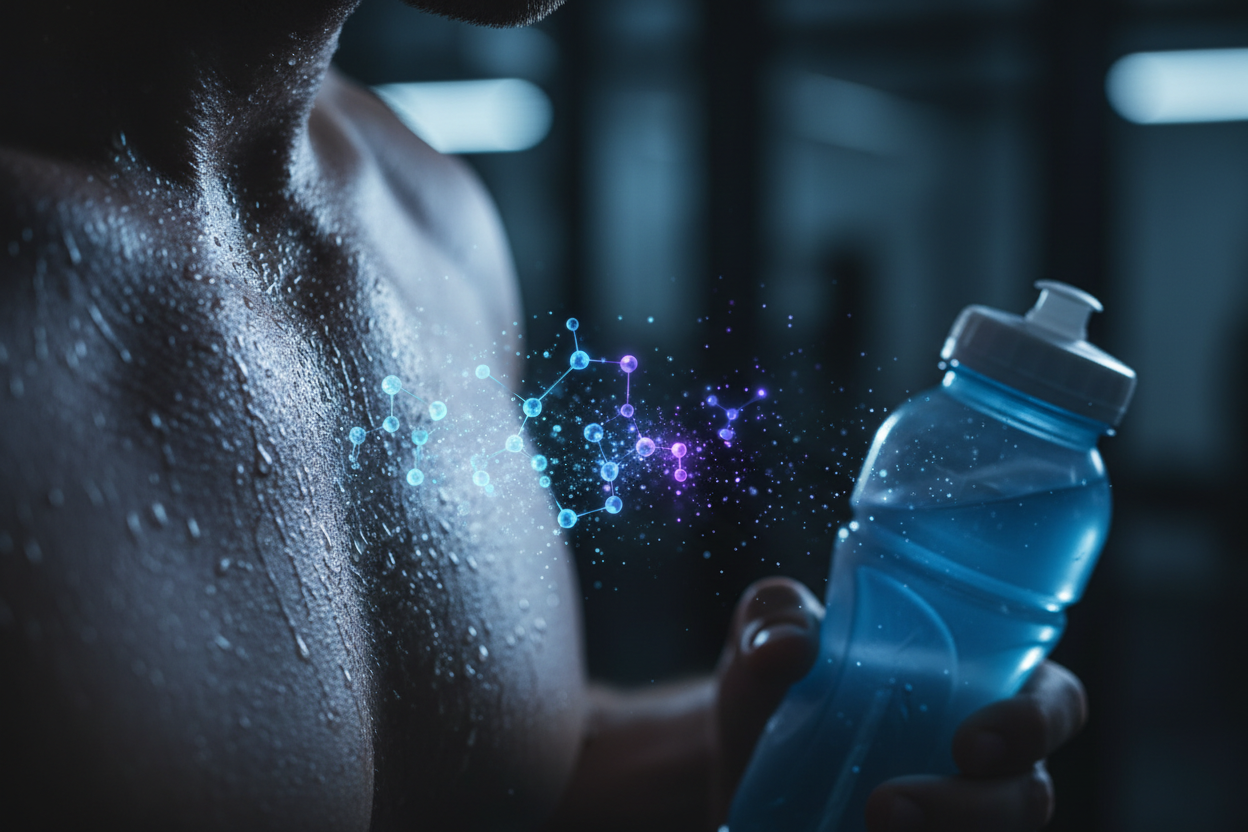
Ion-Exchange Resorption Metrics: The 343% Plasma Amino Acid Deficit
This article exposes a critical flaw in conventional hydration strategies by quantifying that one hour of sweating drains a staggering 343% of the body's total circulating High-Demand Amino Acids (HDAAs).
Driven by active ductal ion-exchange mechanisms that sacrifice amino acids to resorb sodium, this rapid clearance empties plasma nutrient pools. Because standard electrolyte drinks fail to replace this nitrogen loss, the body is forced into immediate skeletal muscle catabolism to preserve homeostasis.
The study establishes a clinical rationale for combined HDAA and electrolyte rehydration to protect muscle integrity.

The Triage Hierarchy of Aging: Overcoming Renal Nitrogen Limits via Targeted HDAAs
This article applies Bruce Ames’ Triage Theory to aging, demonstrating how nutrient scarcity forces the body to prioritize short-term survival over long-term cellular maintenance. It identifies a key catabolic triad driving sarcopenia—inactivity, low intake, and declining digestive efficiency—which severely limits amino acid absorption.
Crucially, the study illustrates how standard high-protein diets risk inducing harmful aminoaciduria in patients with renal limitations.
Ultimately, it provides evidence that targeted free-form High-Demand Amino Acid (HDAA) replenishment safely stimulates muscle protein synthesis and preserves skeletal lean mass without overloading renal nitrogen pathways.
More Than Hydration. More Than Recovery.
We’re building the next generation of amino acid supplementation. Targeted. Transparent. Trusted by professionals. Explore the science. Understand your sweat. Fuel smarter.
Because both products contain free-form amino acids, they’re rapidly absorbed without requiring digestion – meaning they go to work when your body needs them most.